
At the Seams: Kristine DeNinno Finds Meaning in What Holds Us Together
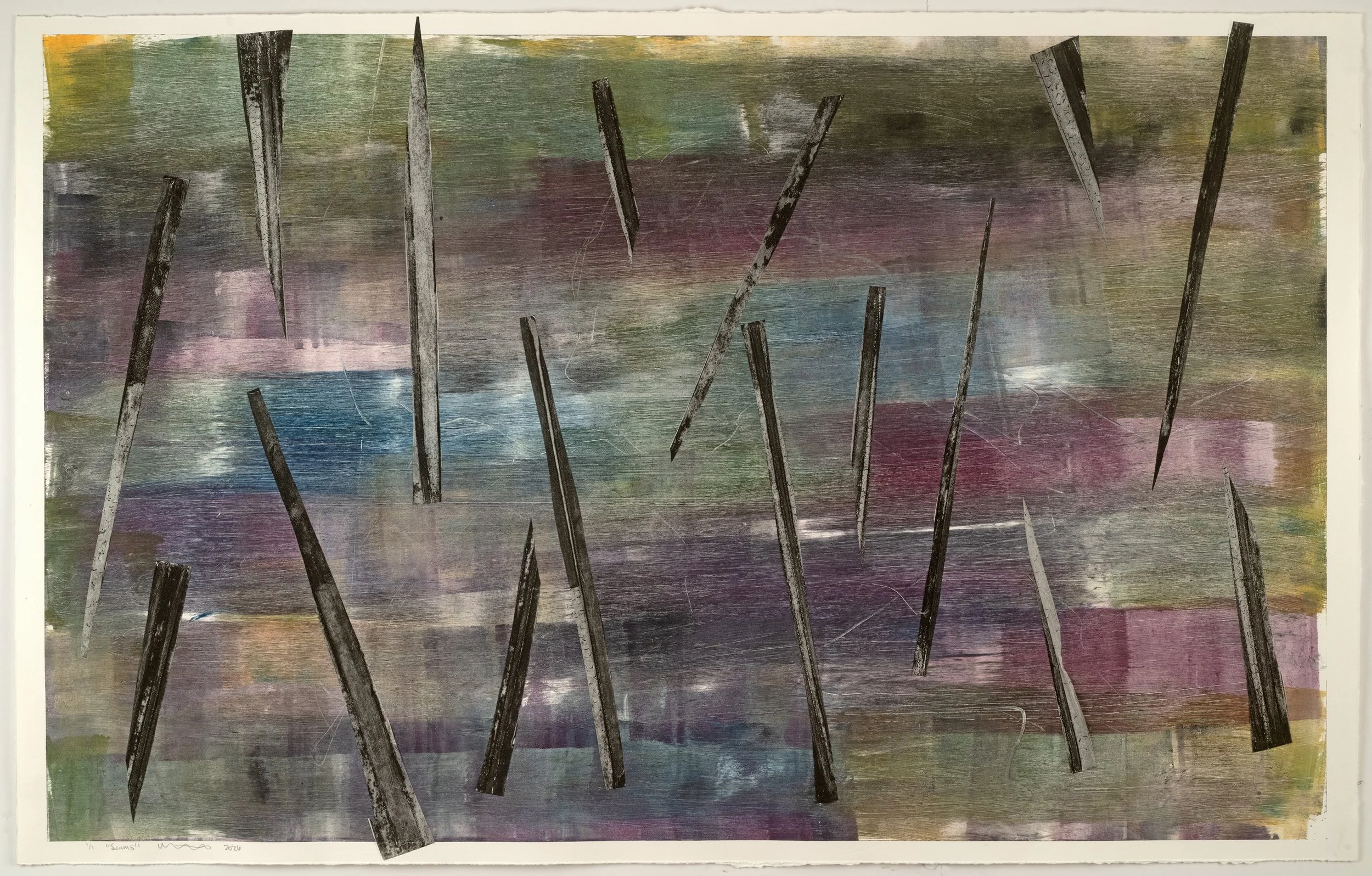
Printmakers understand that meaning often emerges through accumulation. Images are built layer by layer, shaped by revision, chance, and the traces left behind by process. It is fitting, then, that Kristine DeNinno’s newest exhibition, At the Seams, speaks so directly to ideas that resonate within contemporary printmaking.
On view at Washington Printmakers Gallery from September 3–27, At the Seams continues an investigation that has become central to DeNinno’s practice: the interplay between structure and vulnerability, memory and material, fragmentation and repair. Visitors familiar with earlier exhibitions such as Transitions and Women’s Work will recognize recurring themes, yet this new body of work feels especially focused and refined. Here, DeNinno distills years of exploration into a compelling meditation on connection and transformation.
Working with large-scale monoprints, collage, and references to stitching and fiber, DeNinno has developed a visual language that resists easy categorization. Her work occupies a fertile space between printmaking, painting, and textile traditions. Surfaces appear simultaneously constructed and unearthed, revealing layers that emerge, recede, and reappear like fragments of memory.
The exhibition’s title offers an important key to understanding the work. A seam is both practical and symbolic: it joins separate parts, yet it also marks a place of tension where forces meet. Throughout the exhibition, DeNinno embraces this duality. Rather than concealing points of connection, she emphasizes them, inviting viewers to consider the places where histories overlap, experiences converge, and repair remains visible.
Among the exhibition’s highlights is Seams, a monumental monoprint with chine collé on Arches watercolor paper measuring 27 by 41 inches. The work demonstrates DeNinno’s mastery of scale, surface, and material complexity. Broad passages of translucent color interact with embedded papers and gestural marks to create a composition that feels both expansive and intimate. From a distance, the image appears unified; closer inspection reveals a rich network of textures, edges, and layered decisions.
What has long distinguished DeNinno’s work is its emotional depth. Although largely abstract, the prints rarely feel detached. Instead, they invite viewers to bring their own experiences into dialogue with the work. Fragments surface and disappear, boundaries dissolve and reform, and layers accumulate like records of lived experience. The result is work that asks not only to be seen, but also to be remembered.
Themes of transformation have informed much of DeNinno’s recent practice. Transitions explored movement between states and dimensions, while Women’s Work reflected on resilience, labor, and the often-unrecognized contributions of women through layered imagery and references to fiber traditions. In At the Seams, these concerns converge. The exhibition is less about separation than about the possibility of connection. The seam becomes not a fault line, but a meeting place.
There is something particularly resonant about this perspective today. In a cultural moment often defined by division and fracture, DeNinno’s work suggests another way forward. The prints propose that repair can remain visible, that vulnerability can become a source of strength, and that what binds us together may ultimately matter more than what pulls us apart.
Visitors to At the Seams will encounter work that rewards sustained attention. These prints are materially rich, visually sophisticated, and deeply human. They remind us that the most compelling stories are often found not in polished surfaces, but in the places where pieces join, overlap, and hold.
For printmakers, a seam is never merely a seam. It is evidence of process, a record of making, and a point of connection. In Kristine DeNinno’s hands, it becomes a powerful metaphor for how we live, remember, and remain connected to one another.
- by Barbara Bitondo